Math Lunch
A Community of Mathematical Discovery
Upcoming Events
Previous Math Lunches
This research introduces a novel two-stage cluster randomized design, the order restricted cluster randomized block design (ORCRBD). The ORCRBD builds upon the cluster randomized block design by incorporating a second layer of blocking, achieved through ranking cluster units that are randomly sampled from the population. This approach creates a two-way layout, with blocks and ranking groups, and employs restricted randomization to enhance the accuracy of treatment contrast estimation. We calculate the expected mean square for each source of variation in the ORCRBD under a suitable linear model, develop an approximate F-test for the treatment effect, calculate optimal sample sizes for a given cost model, formulate multiple comparison procedures, and apply the design to an educational setting.
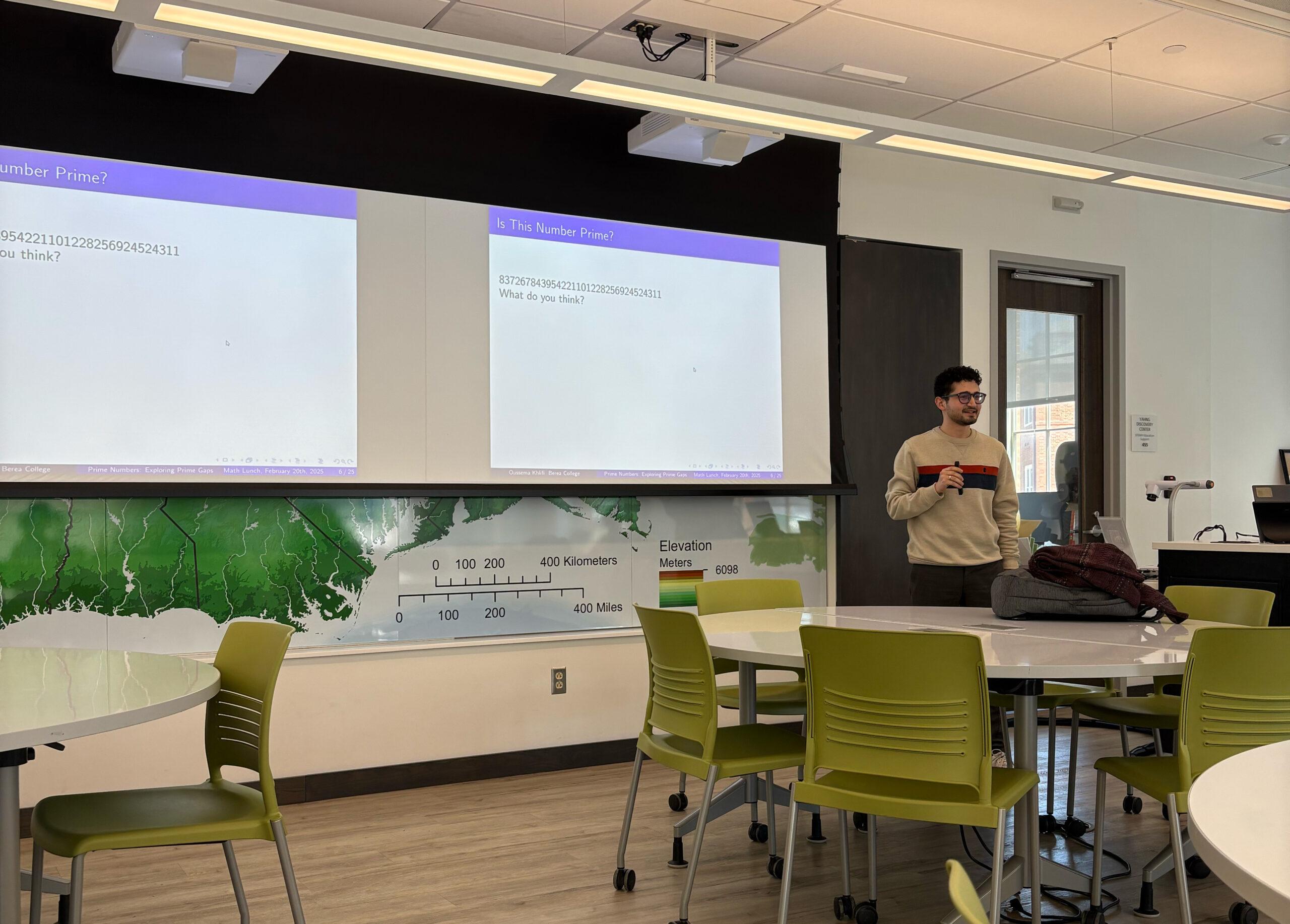
Prime numbers are the building blocks of number theory, yet their distribution remains one of the great mysteries of mathematics. This presentation explores the behavior of prime gaps, the differences between consecutive prime numbers, through a probabilistic and analytical lens.
Everyone talks about the value of a postsecondary education but what do the data say? We look at non-traditional students and how their wages change before enrolling to pursue an associate degree in Kentucky and what their wages look like eight years later. We also look at how these learners compare relative to the entire commonwealth both before and after this time period. The concept of income mobility is discussed throughout the presentation.
What does origami have to do with math? Come learn to fold an origami crane with Dr. Bouchat, while also exploring the mathematical concept of colorability and how the two relate.
We will see how to construct deep neural networks that can arbitrarily well approximate/compute the square function x ↦ x² and the product function (x, y) ↦ xy. Once our networks can compute those two functions, they can compute any polynomial, and, therefore, thanks to the celebrated Stone-Weierstrass Theorem, they can approximate any continuous function with arbitrary precision.
Riding bikes is a crucial piece of a larger transportation sustainability puzzle. Bikes are some of the most energy-efficient machines we have. In cities with car-prioritizing infrastructure (e.g. most US cities), choosing bike routes that feel safe can involve considerable detours. Fortunately, many cities have begun retrofitting car-centric infrastructure with more bike-friendly features. This raises the question: what are the “best” roads on which to build bike-friendly infrastructure in order to minimize the amount of safety-detouring?
In 1973, Conway and Coxeter published an article in the form of several questions which introduced an object called a frieze.
In more recent years, these Conway-Coxeter friezes and their higher-dimensional analogues have been studied due to their relationship to cluster algebras.
Dr Hineman will be sharing some of his current work in the applied mathematics industry and has requested that we reach out to the CS department and majors. In particular, he’s interested in speaking to “coders who can math” as well as “mathers who can code”. I’m very excited to share that GDA is a pioneer in the burgeoning field of Topological Data Analysis. Dr Hineman’s talk will touch on this as well as other computational techniques.
DataFest is a nationwide event where students compete in teams to apply statistical and analytical knowledge to answer interesting questions about a massive donated dataset. Join this year’s Best in Show team (spring 2025) as they tell us about the event and their experience!
Join us for a discussion of ‘Shall I compare thee to a network?’: Visualizing the Topological Structure of Shakespeare’s Plays, a paper by Bastion Rieck and Heike Leitte. https://doi.org/10.11588/heidok.00023477
Dr Clinton Hines will discuss topology and how this computationally driven, topology-based analysis of Shakespeare’s works, explores new methods for “visualizing the structural differences in Shakespeare’s plays.”
In the UK, McDonalds once sold Chicken McNuggets in packs of 6, 9, and 20. If a particularly picky eater wanted to consume exactly 43 Chicken McNuggets, the restaurant would not be able to provide that quantity (This phenomenon is well-documented: https://www.youtube.com/watch?v=vNTSugyS038).
Turns out that this dilemma is very closely related to the Frobenius Number of a numerical semigroup. We will discuss what a numerical semigroup and how Chicken McNuggets can serve as a intermediary between algebra, geometry, and combinatorics. This talk will not assume any prior knowledge and is intended for mathematicians of all levels.